DrupalCon News & Updates: International Splash Awards Celebrate Excellence in Drupal Innovation at DrupalCon Rotterdam 2026
Rotterdam, Netherlands, 28 September 2026. The International Splash Awards 2026 concluded today during DrupalCon Europe in Rotterdam, celebrating the world’s most outstanding Drupal projects, agencies, and developers. The annual awards recognize excellence in design, innovation, technical achievement, and community impact across a range of categories.
The range of entries shows how powerful Drupal as an Open Source system truly is. From municipal websites to apps that connect parents in developing nations to expert childcare advice, the competition this year was fierce.
— Hilmar Kári Hallbjörnsson, head of jurors, International Splash Awards
ImagePhoto Credits: Joris Vercammen
Following the successful return of the International Splash Awards in 2025, this year’s competition saw an even greater participation from across the global Drupal community, receiving 40% more submissions than the previous year. A distinguished jury of independent experts in web design, user experience, open source development, and digital strategy evaluated entries across criteria including concept, execution, emotional appeal, accessibility, performance, innovation, and social relevance.
Winners & Highlights AI-Enhanced Experiences- Winner: blökkli — the open-source in-page editing experience for Drupal by Liip
- Runner-up: Atelier by AIncient Labs — the AI-first Website Studio built on Drupal by Factorial.io
- Winner: Finstral Compendium by Factorial.io
- Runner-up: Building the Digital Museum: How Drupal Powers the Belvedere's Entire Ecosystem by acolono
- Winner: Drupal as a foundation for continuous improvement: The digital ecosystem of The Hague University of Applied Sciences by Netvlies
- Runner-up: Volkswagen AG InfoPortal by drunomics GmbH
- Winner: Transforming Three Global Travel Brands with One Drupal Platform by Zoocha
- Runner-up: pharmaSuisse “Fakten & Zahlen” — interactive data visualisation by Liip
- Winner: Luiss Corporate website, Design system and AI search by SparkFabrik
- Runner-up: Wageningen University & Research - How WUR replaced a fragmented web landscape with one central, AI-powered Drupal platform by iO
- Winner: The AI the EU could actually trust: EPSO's source-grounded answer engine by Dropsolid AI
- Runner-up: From Scripts to Sovereignty. How Pidpa replaced contact centre overhead with auditable, citizen-facing AI by Dropsolid AI
- Winner: Health First: Multiple Audiences. One Drupal Platform by Vardot
- Runner-up: Turning 350 Healthcare Career Options into One Clear Journey by Reading Room
- Winner: Empowering healthier lives: a platform for awareness, prevention and action for diabetes by SWIS
- Runner-up: UPD Foundation Advisory Cockpit by Factorial.io
- Winner: pharmaSuisse “Fakten & Zahlen” — interactive data visualisation by Liip
- Runner-up: From Print to Digital Storytelling: How STAN Magazine Reimagined Publishing with Drupal by ImageX
- Winner: blökkli — the open-source in-page editing experience for Drupal by Liip
- Runner-up: Dutch Safety Region South Limburg: Empowering citizens through digital crisis communication by 1xinternet
Photo Credits: Joris Vercammen
The International Splash Awards serve not only to honor outstanding work but also to inspire collaboration, share best practices, and elevate the broader Drupal ecosystem. The projects recognized this year demonstrate the diversity of ways Drupal can be used to create meaningful, accessible, innovative, and high-performing digital experiences.
From ambitious public platforms and global corporate ecosystems to innovative applications and community-focused initiatives, the 2026 winners showcase the scale and maturity of Drupal as an open source digital experience platform.
Beyond the projects themselves, the Awards celebrate the people and organizations behind them. Many participants contribute to the Drupal community through open source development, modules and distributions, conference talks, training, mentoring, and knowledge sharing.
Thank you to eSepia for sponsoring the International Splash Awards this year. And also thank you to Acquia for doing the interviews.
Looking Ahead: 2027 & BeyondWith the 2026 edition now behind us, the International Splash Awards will continue to evolve alongside Drupal and the wider digital landscape. As organizations face increasingly complex challenges around AI, accessibility, privacy, sustainability, digital sovereignty, and user experience, the Awards will continue to recognize projects that demonstrate how open source technology can meet these challenges with creativity and purpose.
ImagePhoto Credits: Joris Vercammen
The International Splash Awards will return in 2027, continuing its mission to bring the global Drupal community together and celebrate the people, ideas, and projects shaping the future of the open web.
About International Splash AwardsThe International Splash Awards is an independent, global awards program that highlights exceptional Drupal-powered websites, applications, and digital solutions. Its mission is to recognize creativity, technical excellence, and social impact within the Drupal and open-source communities.
The Splash Awards have been organized as regional competitions in Drupal communities around the world for many years. In 2018, the Splash Awards went international, giving outstanding projects from across the globe the opportunity to compete on a global stage. Following a break, the International Splash Awards returned in 2025 and are now an annual fixture at DrupalCon Europe.
For more information about categories, submission guidelines, jury members, and past winners, visit https://splashawards.org/.
The Drop Times: Acquia Cuts DrupalCon Booth Spend to Donate $50,000 to Drupal
Specbee: Tired of adding Webform fields one by one? AI Webform Generator builds Drupal forms from a single sentence and checks every AI output first.
Morpht: What's new in the Drupal AI Views Agent: Simpler prompts and a build assistant
Drupal blog: DriesNote Rotterdam: Drupal is light-years ahead of its reputation
Dries Buytaert opened DrupalCon Rotterdam with a tour of a platform moving at remarkable speed. Multilingual sites that take a fraction of the effort to build. Components written in React. Headless delivery across five frameworks. AI assistants that connect directly to your content. A pipeline of innovation that has Europe's push for digital sovereignty looking closely at Drupal.
Then he named the problem: hardly anyone outside this community knows. The market's picture of Drupal runs years behind what the platform can do today.
Rotterdam has a saying: "Niet lullen maar poetsen." Stop talking, start working. Dries argued we have taken that advice almost too well, and he flipped it. The work is done. Now it's time to talk louder about what is working, and for the first time, that work earns contribution credit.
Here is what he covered.
Europe needs digital sovereignty, and Drupal is readyDries opened with a challenge facing Europe: reducing its dependence on technology it does not control. When the European Commission asked for feedback on digital sovereignty, Dries submitted his thinking, and his writing was referenced in the official policy recommendation that followed.
His point: open source projects like Drupal offer more than software. They offer ongoing maintenance, security releases, and a global community of care. He gave it a name he hopes will catch on: Stewarded Open Source.
For governments and organisations that need control over their digital infrastructure, Drupal is exactly that: open source with a steward, proven at scale, and owned by no single vendor. As Dries put it: "Europe needs Drupal. And Drupal needs Europe too."
Innovation is back, and it is reaching new peopleTwo years after launching the Starshot initiative, Dries reflected on what it delivered: Drupal CMS, recipes, site templates, Canvas, and a wave of AI tools. Then he showed four ways Drupal is bringing its strengths to more people:
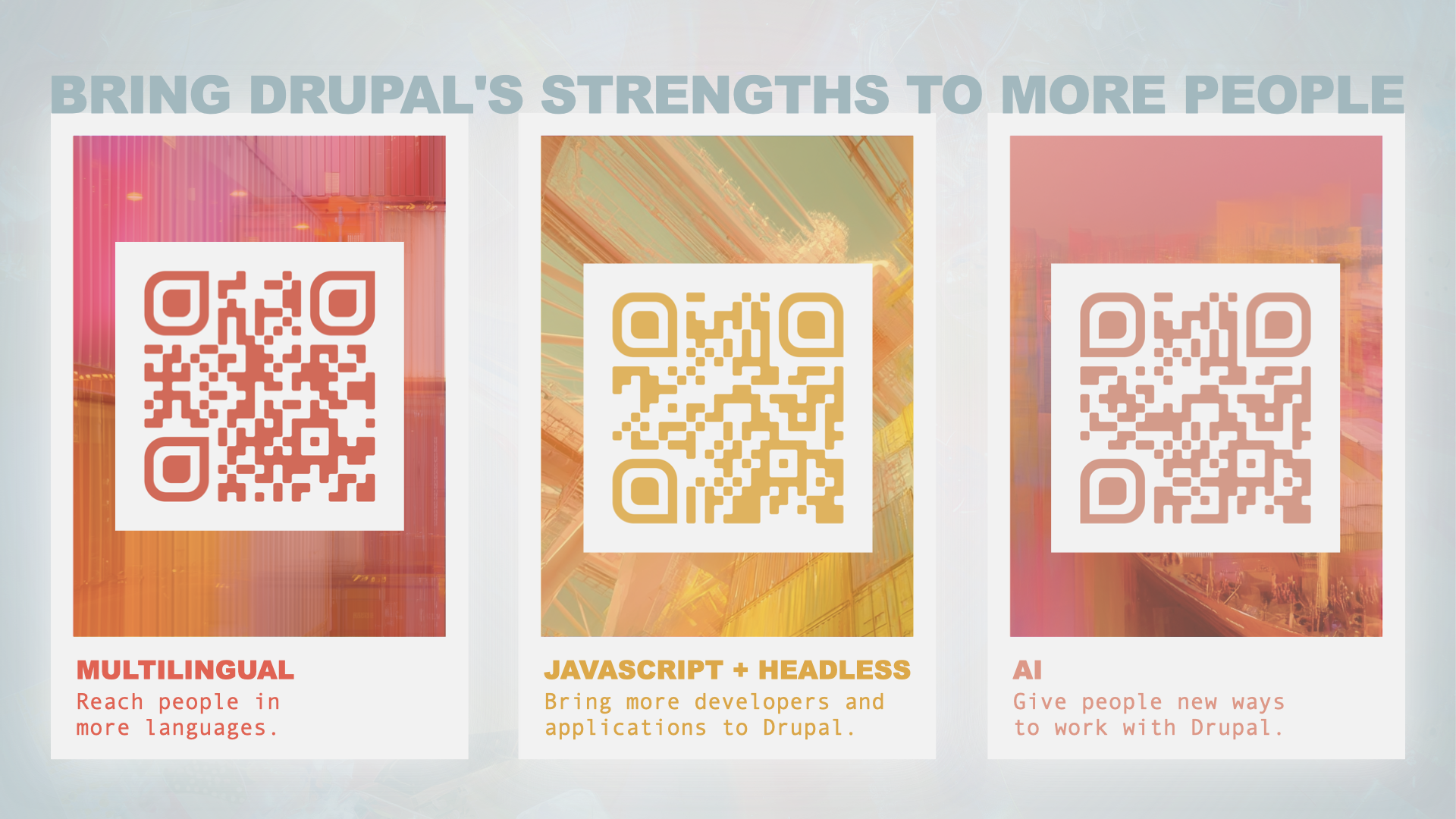
- Multilingual. Building multilingual sites is now dramatically simpler, and Drupal Canvas fully supports multilingual content.
- JavaScript. Canvas code components can be written in React, treating JavaScript developers as first-class citizens.
- Headless. Official headless support now spans five frameworks, including newly added Angular.
- AI. A new public demo site lets anyone explore Drupal's AI capabilities, made possible by the partners of the Drupal AI Initiative.
You can already connect an AI assistant to a Drupal site using a recipe that combines Simple OAuth, MCP Server, and the Tool module. Dries demonstrated it on his own photo album module, built to answer questions like "Do you have that photo of Oma wearing her sunglasses?"
Fully exposing his module's capabilities took around 1,000 lines of code. A research prototype built with Matt Glaman reduced that to roughly 20 PHP attributes. Describe a capability once, and it becomes available everywhere: to AI assistants, to workflow tools like ECA, to JavaScript components, and to humans who never touch AI at all.
The Rosetta Sprint: one description, readable by everyoneTo turn the prototype into a shared roadmap, Dries announced the Rosetta Sprint. Like the Rosetta Stone, which carried one decree in three scripts, the goal is for Drupal to describe its capabilities once, in a way that AI agents, other systems, and humans can all read.
The sprint will bring key maintainers together for four days of focused work.
The Drupal Advocacy Program: contribution credit for talking about DrupalDries named Drupal's reputation gap as the project's number one challenge. Too many people are judging the Drupal of ten years ago, and AI systems trained on old information repeat that outdated story.
His answer is not hype. "Drupal doesn't need hype. It needs a better public record."
So the Drupal Association is launching the Drupal Advocacy Program, a pilot that awards contribution credit for work that helps people discover and understand Drupal: writing tutorials, recording demos, translating articles, amplifying someone else's talk. Each quarter, a focus theme with a ready-made source kit earns double credits.
Submissions open today at drupal.org/advocacy.
Start now, in RotterdamDries closed with the Rotterdam Pilot: a challenge to everyone at DrupalCon to turn the buzz in the room into buzz outside it. Share a takeaway. Clip a talk. Write about someone else's session and credit them.
"Drupal is now light-years ahead of its reputation," he said. Closing that gap is work we can all do, starting this week.
Slides will be posted at dri.es.
File attachments: Europe Needs Drupal.png QRCodes.png LightYearsAhead.png

Cheppers: ExperienceKit: Web Accessibility at Scale - Audit Components Once, Not Pages Forever
Jacob Rockowitz: Vibing Drupal: Tale 1 - Using AI to build and contribute a module
Introduction
I use AI every day to accomplish a variety of tasks. I'd like to share three tales about building, maintaining, and contributing to different Drupal modules. My goal is to discuss how I use AI and what I use it for.
At the same time, I am not trying to teach you how to use AI because I've noticed a nuance: AI can teach you how to use AI. For example, you can point an AI at this post and ask it to read the post, follow the links, and explain how things are being done. For me, open source and Drupal have always been more about sharing ideas, experiences, and stories, as well as code, allowing humans and their AIs to learn from or be inspired by each other's experiences.
My three tales are meant to be told in a specific order: building a greenfield project, maintaining a brownfield project, and contributing to someone else's project. Because of how AI works and the increased use of spec-driven development, people are discussing projects in terms of greenfield vs. brownfield. Ironically, I don't think of Drupal as greenfield or brownfield, but as infrastructure that fields and projects sit on top of. The most fundamental greenfield project in Drupal is building a new site for an organization, and for contributions to Drupal, building a new module.
Building a module using AI
Building a Drupal module with AI isn't new. I've written several posts that range from learning to build a Drupal module using AI to having AI build a module. The most recent module I've "built" with AI and contributed back to Drupal has a unique nuance: the initial code and solution came from an existing client project we are modernizing, and I had AI...Read More
The Drop Times: Rotterdam Puts Drupal’s Biggest Bets to the Test
Perhaps the most revealing thing about DrupalCon Rotterdam is that its programme does not tell one tidy story. Drupal is preparing to discuss its transformation into a production-ready Agentic CMS while another session asks, quite directly, why developers still do not choose Drupal. Canvas has become central to Drupal CMS, yet Rotterdam will also put it against Display Builder in a real-world project. Those collisions matter because Drupal’s next phase depends less on any one initiative succeeding than on whether these different bets can reinforce one another without carrying old friction forward.
Connecting Drupal to models and agents is no longer the difficult part of the AI story. Rotterdam moves quickly into hallucination, reviewer trust, orchestration, governed workflows and human control because production use raises harder questions about what an agent may do once it can act rather than merely answer. Permissions, auditability, validation and human approval are becoming part of the product itself. If the Agentic CMS idea is going to mean more than a collection of AI capabilities, those boundaries have to become as deliberate as the capabilities they constrain.
Adoption tests another part of the same argument. Drupal CMS 2.0, Canvas, Recipes and AI-assisted tooling have changed the product presented to builders, but improved technology does not automatically change how Drupal is perceived beyond its existing community. “Why Developers Don’t Choose Drupal” puts that gap unusually plainly. The useful evidence from Rotterdam will not be another inventory of features, but signs that newcomers can enter the system more easily, that organisations are choosing Drupal CMS rather than only inheriting or upgrading Drupal, and that the new experience removes barriers people outside the community can actually feel.
Digital sovereignty makes the question more demanding because Drupal is also being asked to apply its values inward. A Rotterdam discussion on FAIR asks whether sovereignty, governance and cost problems in Drupal’s own software distribution could be addressed differently, starting from Drupal.org’s role as the ecosystem’s central distribution point. That turns openness from something Drupal offers its users into something its own infrastructure may need to demonstrate. Arguments about control become more credible when the project is willing to examine where dependence, responsibility and operational burden sit inside its own systems.
Discovery may be where all of these threads become visible from outside. A Rotterdam discussion on Drupal’s representation in ChatGPT, Gemini and Claude starts from the recognition that developers and decision-makers increasingly encounter technologies through AI-generated answers as well as conventional search. Drupal therefore has to become easier to understand, evaluate and trust not only for people already inside the ecosystem, but also for the systems mediating their choices. Rotterdam will not settle all of that in four days. What it can reveal is whether Drupal’s current direction is beginning to cohere: a product easier to adopt, agents with clearer limits, infrastructure consistent with its sovereignty claims, and a project that can explain its relevance wherever technology choices now begin.
Follow The DropTimes on LinkedIn, X, Bluesky, and Facebook, or join #thedroptimes on Drupal Slack.
Kazima Abbas wrote and curated this issue of Editor’s Pick.
Joachim's blog: A great leap backwards: fixed configuration
Drupal's configuration system has at its heart a key concept: the site owns the configuration. What that means is that after a module has provided install configuration, it no longer has any control over it. You, the site admin, can change that config or even delete it. The module is no longer involved.
This kept the configuration system simple (up to a point); after all, the development of this system was one of the harder parts of the lengthy and difficult Drupal 8 cycle ("The ConfigImporter class was written with a get this done and working attitude" wrote @alexpott on a core issue, and I think the same could be said of the configuration system as a whole).
Since then, the config transformation API was added, and various modules have been created that take advantage of this, such as Configuration Split and Config Merge. These still work in the paradigm of the site owning the configuration. But what if we could turn the clock back, just partially, to when modules could own config too?
The (different) old daysIf you were around in the days of Drupal 7, you may remember the various default hooks. Modules such as Views and Flag exposed a hook which allowed modules to define configuration items. (These were not configuration in the modern sense, because there wasn't that concept at the time, but referring to them as such makes things simpler.)
These were thus a code-defined instance of a type of thing that could also be defined in the UI by site admins. A module could supply a default view, and rely on it always existing. A new release of a module could come with enhancements to a that view, and they would exist on the site as soon as the module code was updated to the new version.
Because these hooks were PHP code, it was also possible for configuration to dynamically depend on other aspects of the site. You could do something such as define a default flag for every node type.
The ideaFor a long time, I've wondered if something similar could be possible with Drupal's configuration system: put simply, defining configuration in code. Or, as I'm calling it, fixed config.
Many modules, such as Drupal Commerce and LocalGov Drupal rely on configuration items which are essential to their functionality (what I call machinery). Drupal's paradigm of configuration being owned by the site means that a site admin can break or outright delete key parts of the module's functionality: a commerce system missing its cart view, or a directory system missing its node types and vocabularies.
There's a case for admins being able to enhance and tweak a module's machinery, but that leads to the problem of how to reconcile a site's changes with changes that come in a new version of a module. There are modules that aim to help with this, but configuration entities are complex data structures, and without in-depth knowledge of that structure, this is a difficult and painstaking task. Some modules take care of this in update hooks each time they want to change their machinery, but that also requires complicated work each time.
The final push to get me to work on this was the use case of Entity Pager: the maintainer of the Flippy module suggested merging the two modules. But while Entity Pager provides the means for site admins to create any pager for any entity type, Flippy's functionality is to automatically provide a pager for each node type on the site. It seemed to me that the way to achieve this feature on top of Entity Pager was to have a way for the Flippy module to define an entity pager view automatically for each node type. The same way that Drupal 7 default hooks could.
Could this be done within the modern Drupal config system? The module would be in charge, not the site. If the module's code updated and changed the definition of the config, then the site would pick up on that.
Developing the moduleThe basic requirement is to add config entity definitions that are coming from code.
I could see two ways of doing this: intercept the entity storage handlers, or intercept the config transformation API. I opted for the latter. Partly because working at the entity storage level would require decorating every config entity type storage handler, which seemed heavy-handed, and because working within the config system has its advantages, and finally because one general principle I have found over the years is that complexity should generally be pushed down in a system. The config system is beneath the entity system, so working there would mean that this would be completely invisible to the entity system which would just see some additional entities.
So, I experimented with the config storage transformation API. Could I make it see, for example, a hardcoded node type? The answer was yes: it's simple to add an additional config entity in the STORAGE_TRANSFORM_IMPORT event, and the site sees it just as if it were some other piece of config.
Then the real development work started: making the config system read the fixed config, but also ignore it when necessary. I decided on this simple rule:
- Fixed config is not exported to config sync. Instead, it is always re-created from files on config import.
On Drupal 7, some (but not all) default hooks had a concept of overriding. The site admin could choose to edit a default object, such as a view, and deviate from the version in code. From that point on, the site owned that object, not the module.
I've decided, for now at least, not to support overriding. I think a better, and simpler, pattern is to allow selection of config: the module provides machinery, but also provides a setting to select it as being in use. For our example of the commerce cart view, there would be the fixed config view, and also a config setting where you select which view is used for the cart. This means that the default view remains under the control of the commerce module, but a site admin can duplicate it, change the duplicate, and then use that one instead. The site then owns the duplicate view, but the default view remains available and functional at all times.
The Alpha-1 APIHaving got a proof-of-concept, the next step was to design an API too. Rather than use hooks or an event, I decided fixed config should look the same as install config: YAML files. The big advantage here being that while developing it, you can move YAML files from sync or install folders to become fixed config. And it provides a system that is already familiar to developers: fixed config is simply a YAML file in a module's config/fixed folder instead of config/install. (I made a small change and a new release of Config Devel so that its module config export feature works with this folder too.)
But static YAML files doesn't cover all the use cases that the Drupal 7 era hooks used to satisfy. So I added the concept of derivers. We already have plugin derivers in Drupal (and maybe I should have tried to think of a different name); but these are config deriver plugins: they create multiple config items from a single template.
So while a static fixed config file looks identical to an install config file, a derived fixed config file has these additions:
third_party_settings: fixed_config: deriver: deriver_plugin_id dependee_config_patterns: - node.type.*What this means is that when config whose name matches node.type.* is created or updated, the fixed config deriver plugin deriver_plugin_id reacts, and maintains the fixed config based on the YAML file that holds these properties.
The node type config entity is the dependee config; the fixed config that gets defined in response to that is the dependent fixed config.
This is how the Flippy module could then work: it defines a single fixed config YAML file for a view, and a deriver plugin which alters these config values:
- Sets the value of the node type filter.
- Sets the path for the page display.
I find that you never fully realise what an API needs to do or how it needs to work and how to best make it usable until you actually try to use it, and that therefore it's best to do that early on.
I started making the Entity Pager view, and I was soon struck with several things about what I'd made:
- Code that sets a view's entity bundle filters to an incoming bundle entity should be reusable.
- Code that adds the incoming entity's ID as a suffix to the view's path should be reusable, but not necessarily by the same things as the first.
- As well as deriving a single view for each node type, it might be useful to have a single view which adds a new display for each node type.
That reusability feature could be solved by using PHP traits, and requiring developers to composite them into their plugin classes. Or it could be solved by making the plugins themselves smaller, and allowing the deriving process to specify more than one. A pipeline, basically.
And the many-to-one feature could be solved by letting code alter the fixed config YAML file values, rather than deriving from them: the same config values get processed by the PHP code for every config entity it listens for, rather than making a new copy each time.
To me, this suggests a new type of plugin, fixed config alterers, which can do the work in both of these scenarios.
So what I am pondering now would look like this:
- For derived fixed config:
- The fixed config deriver plugin does the bare minimum to the config values from the YAML file.
- The config values are passed through multiple alterer plugins.
- For static fixed config:
- If config patterns are specified, the config values are passed through alterer plugins for each config matching the pattern.
- A better name is needed as it would no longer be completely static!
Am I over-engineering, I wonder? Also, the pipeline of alterers seems very much like the Migrate API's pipeline of processors, but I don't see how to reuse those as they operate on different sorts of values: entire config entity values for my case, and single content entity field values for Migrate.
I'd be interested in hearing ideas and use cases for the fixed config module. It would help me with the process of refining my initial ideas for the API.
I've made an alpha release, try it out and let me know what you think, either in the issue queue or on mastodon.
Do you have potential uses for fixed configuration? I'd love to work on this module with some real-world use cases, and I'm available for hire - contact me!
joachim Mon, 28/09/2026 - 11:05 TagsBloomIdea: Measuring ChatGPT ads on Drupal, from the browser and from the server
Since September, advertisers in Europe can buy ads inside ChatGPT, and the Ads Manager asks for two things before it can tell you whether they work: a measurement pixel in the browser and, ideally, conversions sent from your server. On a Drupal site that usually means pasting a snippet into the theme, writing the order_created call by hand in a template, and trying to hide the whole thing behind the cookie banner. Then the order paid by bank transfer or payment reference hours later, confirmed by a webhook, never shows up, because no browser was there to see it.
Even when a browser is there, the pixel loses part of the picture. Ad blockers stop it outright, Safari caps cookies written by scripts at seven days, and iOS removes tracking parameters from links shared in Messages and Mail and from links opened in private browsing. OpenAI's own documentation calls the Conversions API "a more reliable tracking source than the pixel alone".
We have released a module for this on drupal.org: ChatGPT Ads, free software under the GPL, for Drupal 10.3 and 11, covered by Drupal's security advisory policy. It plugs into Drupal Commerce, Webform and the Klaro consent manager through sub-modules, and sends events through both OpenAI's Measurement Pixel and the Conversions API. It is a community module, not affiliated with OpenAI.
What you can measure- With Drupal Commerce, every product added to the cart, including from an AJAX add-to-cart button, with its SKU, quantity and price.
- The start of checkout, and the order itself when it is paid, not merely placed, so an unpaid bank transfer or an expired payment reference never counts as a sale.
- The order paid later and off-site, reported from the server when the payment webhook arrives, with the same event id as the browser, so OpenAI counts it once.
- With Webform, a contact form, a quote request or a newsletter sign-up as a lead: add the ChatGPT Ads handler to any webform and map the email and phone fields.
- Account registrations, from the browser and the server.
- Anything else, with a single call to Drupal.chatgptAds.measure() from your own script.
The pixel goes only on the pages you choose, using the same visibility conditions blocks use: paths, roles, content types, language.
What it refuses to doNothing is requested from OpenAI, and no cookie is set, until the visitor has decided. OpenAI's documentation suggests loading the pixel with consent withheld and granting it later, but the script sets cookies as soon as it loads, so the module does not load it at all until there is an answer.
A visitor who has not answered yet is neither a yes nor a no. Their events wait in memory and go out if they accept, so the landing page is not lost; if they refuse, they are dropped. The Klaro integration reads only decisions the visitor has confirmed, because Klaro reports a service's default from the moment the page loads, which would otherwise be read as a refusal while the banner is still on screen.
The same rule applies on the server. Hashed email, phone, IP address and user agent go to the Conversions API only for a visitor whose consent was recorded at the time of the event. For everyone else the conversion still goes, carrying the click identifier and nothing about the person.
The module never saves an order. Saving inside a Commerce transition can fire that transition twice, which on a live store means duplicate receipts and an error at checkout; the click identifiers are stored on the order when the checkout flow saves it anyway.
Pages stay cachedThe pixel and the settings that are the same for everyone are cached with the page. What belongs to one visitor, the events collected for that page and, with advanced matching on, their hashed account data, arrives through a placeholder rendered on every request. A page carrying the pixel stays in Drupal's Dynamic Page Cache, instead of turning every page on the site uncacheable to deliver one visitor's identity.
Where it came fromIt was built for one of the e-commerce stores we develop in Portugal, where many orders are paid by Multibanco or MB WAY, Portuguese payment methods whose confirmation often arrives hours after checkout. Bank transfers and payment references behave the same way in any country, and that pattern is why the Conversions API is in the first release rather than a later one: without it, those sales are invisible to the ad platform. The pixel, the Klaro gate and the cart events have been running on that store since mid September.
Your consent manager, your choiceKlaro gets a ready-made sub-module: install it and a ChatGPT Ads service appears in the banner, off by default. Any other consent manager reports the decision through a small JavaScript contract, and the README carries a working recipe for EU Cookie Compliance:
Drupal.chatgptAds.consent(true); // granted, now or on a later page Drupal.chatgptAds.consent(false); // refused or withdrawnTo see what else on your site reaches third parties before the visitor decides, Consent Audit records it from real visits.
Get it composer require drupal/chatgpt_adsYou need a ChatGPT Ads Manager account and the pixel id from its Conversions tab. The Conversions API sub-module stores its key through the Key module, so the secret can live in an environment variable instead of your exported configuration. The project page, the documentation and the issue queue are on drupal.org. Bug reports, questions and merge requests are welcome.
Drupal Association blog: Drupal's Got Talent at DrupalCon Orlando 2027!
The inaugural DrupalCon Talent Show is happening at DrupalCon Orlando on the evening of Tuesday, March 23, 2027 as part of the community party!
We’re planning about two hours of entertainment and looking for roughly 10 acts to take the stage (5–7 minutes for the act, plus up to 3 minutes for stage setup).
This is DrupalCon. The goal is to learn, network, and have fun. Expect jokes, friendly razzing, questionable decisions, and plenty of laughs. You don’t need to be a professional. You just need to be willing to get up there and attempt to entertain your fellow Drupalers (within our Code of Conduct https://events.drupal.org/code-conduct, of course!)
What are we looking for?Pretty much anything entertaining:
- Musicians
- Bands
- Stand-up comedy (keep it PG-13 please!)
- Magic
- Singing
- Dancing
- Juggling
- Puppet shows
- Ridiculous feats of skill
- Weird talents you didn’t think anyone wanted to see (we do)
Got something that doesn’t fit on the list? Even better. Solo acts, groups, first-timers, seasoned performers, and wonderfully questionable ideas are all welcome.
Think you’ve got something? Sign up here and show us what you’ve got!
FAQs When is the deadline?The absolute last deadline to sign up is Friday, February 19th. However, submissions are reviewed on a rolling basis as they come in. Once all ~10 spots are filled, sign-ups will close early. We strongly encourage you to submit as soon as possible.
Is there a prize?Likely, but this hasn’t yet been determined. Suffice it to say that the primary prize will be bragging rights!.
How will performances be chosen?Performances will be chosen to ensure a wide variety of performance types, geographical regions, companies, diverse performers, etc. You can increase your chances of being selected by submitting earlier rather than later.
How long should the performances be?5-7 minutes is ideal
Do I have to bring my instrument? Will there be microphones?We will provide microphones for your band (up to four). If needed by multiple performers, we may be able to supply basic instruments. Details will be provided ahead of the performance if you are accepted to perform.
Will there be a bar?A cash (and credit card) bar will be available.
Gspikes: Drupal to WordPress Migration: When Downgrading Is Right
#! code: Drupal 11: Migrating From Jadu Into LocalGov Drupal: Part 4
This is the fourth article in a series looking at migrating from Jadu into LocalGov Drupal (LGD) for the Central Bedfordshire site. In the first article we looked at the Jadu API itself and setting things up so that we could make calls to the API and parse the XML data using the migration systems available.
In the second article we looked at reproducing Jadu URLs to create redirects for migrated content, even though the Jadu API doesn't contain any URL information.
In the third article we looked at a more complex example of migration, taking documents and pages from Jadu and creating a guide pages from that data.
Now it is time to move onto what became the most complex part of the Central Bedfordshire migration, which was moving directories data from Jadu to LGD. Directories were used on the Jadu site to store all sorts of information, which included schools, the location of car parks, contact information of homecare providers, and even an a-to-z glossary of recycling. This data served different purposes on the site, but it was all hand created and important to bring across during the migration work.
In this article we will look at the Jadu data we needed to fetch to find directory information, and how that data was injected into the LGD structure available.
First, let's look at how we get directory information out of Jadu.
Jadu Directories APIDirectories in Jadu can be fetched using the directories index at the following endpoint.
philipnorton42 Sun, 09/27/2026 - 18:45HOOK_DEV_ALTER(): PHP Structured Concurrency and Beyond (4): call for backers
The prototype works. Taking it to production quality is more than evenings. Whether it should is a question, not a pitch.
One thing before the rest. I am not pushing this. The series is a question to the world: is this work worth more of my time? We are not in the Federation yet, so more time means money, and money means backers. Any answer is fine with me, including no.
HOOK_DEV_ALTER(): PHP Structured Concurrency and Beyond (3): structured state, and why its absence breaks concurrency
Every framework service that holds state is a bug under fibers. The current fix is to switch concurrency off. There is a third option.
Stuart Clark (Deciphered): Druxt Auth 0.5.0; two ways to sign in without leaving your site
Every Druxt site I have built signs people in by sending them somewhere else to do it: out to Drupal's login page, on to a consent screen, and eventually back. With Druxt Auth 0.5.0 the username and password can now be handled entirely in the frontend instead, either through the authorization code grant or through the password grant.
If you have not used it, Druxt Auth wires Nuxt's auth module to Simple OAuth on the Drupal side. It targets Nuxt 2 today, because @nuxtjs/auth-next does.
The first is the authorization code grant, which now takes credentials directly. Druxt Auth signs the visitor in through Drupal's JSON login route first, so the authorize step finds a session waiting and returns a code without rendering anything:
The Drop Times: amazee.io and amazee.ai Bring Shadow AI and Sovereign Infrastructure to DrupalCon Rotterdam
ImageX: What’s New in ECA 3 And How to Build An Automated Drupal Workflow
Modern, intelligent Drupal websites rely on automation to save teams plenty of time. Tools like Drupal Cron handle scheduled tasks at set intervals, but not every automated workflow is tied to a schedule. Some need to respond immediately to events on your Drupal site, such as a user logging in, an article being published, or a custom form being submitted.
HOOK_DEV_ALTER(): PHP Structured Concurrency and Beyond (2): ownership, and why its absence breaks persistent servers
A coroutine nobody owns is a leak. Under one process per request you never see it. Persistent servers take that away.